

Bio-Critical Profile
Gabriele Brugnaro delineates the figure of a creator whose avant-garde journey unfolds through an unceasing metamorphosis of artistic languages, grounding his research on the concept of layering and temporal evolution.
Active since the 1990s, the artist took his first steps within a rigorous investigation of figurative painting. In this initial phase, the canvas—understood as a classical academic medium—served as a fundamental structural training ground for mastering space and subject matter.
The true turning point of rupture and maturation occurred in 2011, on the occasion of his participation in Arte Accessibile Milano (AAM). Up until the exhibitions immediately preceding this event, the artist's work was still tied to traditional formats and textiles. With the exhibition milestone in Milan, Brugnaro presented his layered works to the public for the first time, executing a structural revolution: the canvas was definitively abandoned to make way for metal and wooden panels.
On these new rigid bases, the surface cracks open, embracing the density of textured painting (pittura materica) and the assembly of reclaimed industrial and anthropic elements.
This marked the beginning of his multi-material sedimentation phase—an analytical journey that, in recent years, has found its natural and coherent culmination in the rarefactions of generative digital graphics and the ephemeral dimension of performance art.
The core of his investigation resides in existential layering: the medium ceases to be an inert surface and becomes a living body—a sensitive palimpsest where memories, traces, and philosophical inquiries sediment over time.
In his contemporary visual architectures, the repeated accumulation of elements evokes an archetypal sacredness, recalling the circular toil of Sisyphus' boulder, the perpetual motion of the Danaides, and the eternal return of the seasons.
The artwork thus becomes a liminal membrane—a permeable threshold guarding and connecting the psychological abyss of the Self with collective reality.
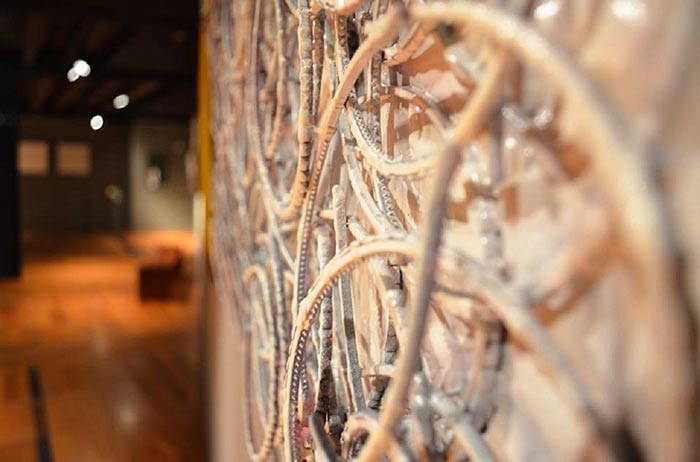
Milleduecento (detail from one of the artist's artworks)
Poetics and Philosophy
The Evolution of Memory: From Figurative to Anamnesis
While memory was entrusted to the fidelity of form during his early figurative phase on canvas, in his maturity, the creative act functions as an anamnestic catalyst of Platonic origin. It awakens the remembrance of the world of Ideas, no longer by imitating reality, but by sublimating the sensible beauty of raw matter and elevating the soul beyond contingent facts.
Temporal Sedimentation as the Flesh of the Artwork
Following his material shift toward rigid panels, time materializes as "flesh" through the geometric and informal juxtaposition of chromatic and polymer layers. The thick density of the artwork asserts itself as a metaphor for the complexity and gravity of human experience, where each layer buries and preserves the one before it.
Redemption of the Industrial Object and Epiphany of the Cycle
The introduction of everyday objects onto wooden and metal panels operates an aesthetic of redemption. The serial repetition of these fragments emancipates them from the cold logic of mass production, transforming them into an existential liturgy and an artistic artifact. The cycle of life is thus reflected in the mirror of man-made objects, inscribing the mundane into the eternal.
The Cognitive Short-Circuit of the Unique Essence
The assembly of identity fragments drawn from modernity generates a perceptive disorientation in the viewer.
From a distance, familiar shapes merge into an abstract, unfamiliar whole. Only a close inspection allows the mind to recognize and reclassify the individual functional modules. This estrangement demonstrates—in accordance with Lucretius' monism and Leibniz's monads—that every geometric and objectual form shares the same primordial substance: everything we perceive is a cluster of shifting formal ideas in perpetual mutation.
From the Material Capsule to Digital Synthesis: The Flow of Alternation
In a future dominated by the immaterial, Brugnaro's textured paintings define themselves as object-memory capsules—physical bulwarks destined to travel through time to speak to future generations.
Far from contradicting this vision, the artist’s subsequent transition to generative digital graphics and performance art represents the closing of the cycle: heavy, layered objecthood sublimates and dematerializes, transforming the material archetype into pure code and algorithmic flux.
However, this dematerialization is not permanent; the artist’s production lives in a pendulum-like motion—a continuous transition between the appearance and disappearance of matter, cyclically alternating dense, layered production phases with digital rarefactions.
Technical Summary
Media
. Oil and acrylic painting on canvas (original figurative phase).
. High-thickness multi-material layerings on metal and wooden panels, integrating anthropic and structural assembly elements (material phase).
. Generative digital graphics and performance art (contemporary phase).
Practice and Alchemy of Matter
His mature research is governed by a rigorous investigation into the sculptural depth of the rigid medium.
Brugnaro weaves the surface through the structural use of plaster and gauze, which act as connective tissues and wounds upon the board or metal plate.
Onto this pictorial skin, he grafts diverse everyday objects—protagonists and fragments of daily modernity. These modules, stripped of their original utilitarian function, lose their identity of use to integrate into a texture that redefines the relationship between the micro and macrocosm, turning the everyday into a trans-temporal material message launched toward the future.
Selected Exhibition History
Institutional Exhibitions and International Projects
. 2018 | Cromie, curated by S. Pasquali, Spazio Martucci 56, Naples, Italy.
. 2014 | #SEEMETAKEOVER, Times Square, New York City, USA.
. 2014 | IV Rassegna di Arte Contemporanea, curated by D. Buso, Casa dei Carraresi, Treviso, Italy.
. 2013 | III Rassegna di Arte Contemporanea, curated by D. Buso, Casa dei Carraresi, Treviso, Italy.
. 1995 | First International Art Biennale, curated by Dame F. Tempra, Malta (featured figurative works on canvas: Vaso con fiori, Figura seduta).
Art Fairs and Research Spaces
. 2011 | Arte Accessibile Milano (AAM), Il Sole 24 Ore Headquarters, Milan, Italy (Milestone exhibition: the artist definitively abandoned the use of canvas to publicly present his new layered works on metal and wooden panels).
. 2009 | Il Corpo – Sopra la pelle, sotto la pelle, curated by G. Chiesa, Studio D'Ars, Milan, Italy.
. 2009 | Vernice Art Fair (7th Edition), ForlìFiera, Forlì, Italy (Early experimental developments of the Layering Cycle).
. 2008 | Mostra collettiva 345, SpazioUno MDA, Milan, Italy.
. 1996 | Miart - International Modern and Contemporary Art Fair, Milan, Italy.


Address: Kfar Mashoun, near the Naamtallah Hardini Church Edde Jbeil-Byblos, Lebanon
Email: [email protected]
Call: +961 3 348919


